
Areas beyond 12 nautical miles are international airspace not under the Maldives’ legal jurisdiction, the Ministry of Defence has said.
The Defence Ministry’s remarks come amid false allegations that the Maldivian territory has been allowed to be used for war purposes.
The Ministry said the United Nations Convention on the Law of the Sea (UNCLOS) is an international treaty that defines the maritime territories of countries and their general rights and responsibilities. The Maldives’ maritime rights are defined under Law No. 6/96, the Maritime Zones of Maldives Act.
As per the law, in addition to the land territory of Maldives and the airspace above it, the sovereignty of the Maldives extends to the internal waters, archipelagic waters and territorial sea, together with its seabed and subsoil and airspace.
The Convention on International Civil Aviation (Chicago Convention) defines the airspace above a country’s territorial sea as sovereign and subject to permission before entering it. However, the airspace beyond this is considered international airspace. Air traffic control services are provided within the Flight Information Regions (FIR) to ensure air traffic safety and security.
Although a country's permission is not required to enter the FIRs within international airspace, air traffic control services will continue to share information and monitor such flights, the ministry said.
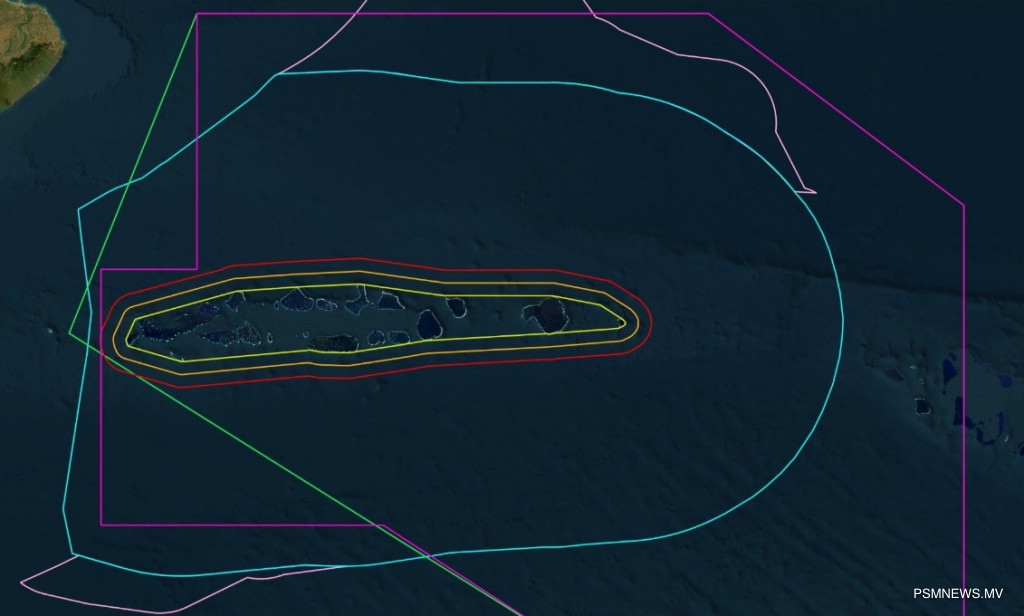
Maldivian maritime zones are defined as follows:
Baseline: reference line defining the start of national maritime zones.
Territorial waters (0-12 nautical miles) – full sovereignty; complete control over water, seabed, and airspace.
Contiguous Zone (12-24 nautical miles) – jurisdiction to enforce laws (customs, immigration, fiscal, sanitary).
Exclusive Economic Zone (24-200 nautical miles) – sovereign rights over natural resources and economic activities.
Extended Continental Shelf (beyond 200 nautical miles) - sovereign rights over seabed and subsoil resources only.
Flight Information Region – responsibility to provide air traffic services and ensure aviation safety.
Search and Rescue Region – responsibility to coordinate search and rescue operations.
The Ministry explained that the Maldives has full jurisdiction over the sea and airspace up to 12 nautical miles. However, decisions regarding use of the airspace beyond 12 nautical miles are not within the Maldives’ control.
The government has reiterated that it will not allow the Maldivian territory to be used to attack any country in the ongoing war in the Middle East.
Defence Ministry clarifies Maldives’ airspace and maritime boundaries

Fetched On
Last Updated
Last Updated


