

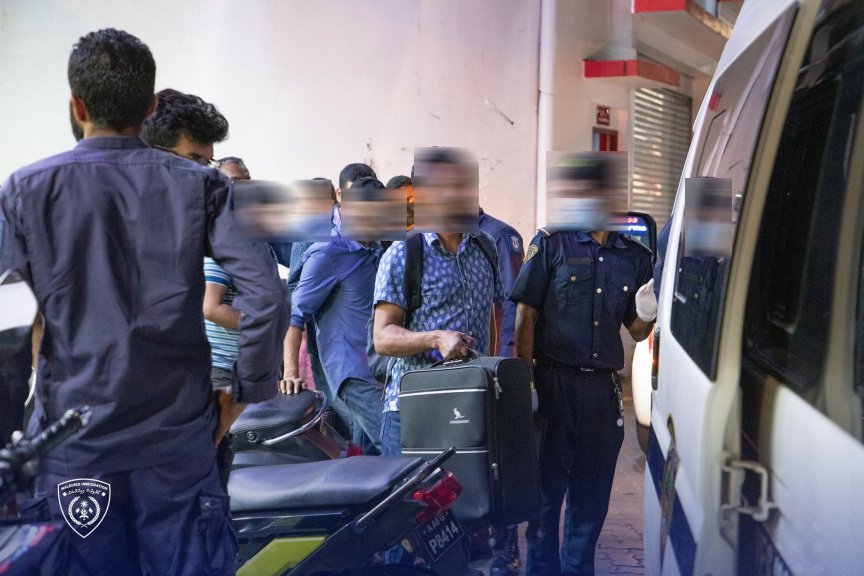
Local human rights group warn that the controversial new night-time checks targeting expatriates will fuel xenophobia, and leave the migrant community in the Maldives even more vulnerable to abuse and exploitation.
On Wednesday, President Dr. Mohamed Muizzu instructed the police to stop and question migrant workers out in the streets and in public spaces between 12:00 am and 06:00 am.
According to him, the decision was made because “some of the migrant workers living in the Maldives are out in the streets in the middle of the night engaging in acts that disturb public order and go against community standards.”
On Thursday, five rights groups issued a statement expressing deep concern over the decision.
Transparency Maldives (TM), Equal Rights Initiative (ERI), Mission for Migrant Workers Maldives (MMWM), Public Interest Law Centre (PILC), and Association for Democracy in the Maldives (ADM) described the measure as “unjustified and discriminatory” in nature, raising “serious constitutional and human rights concerns”.
“The measure targeted at a specific group implies a blanket restriction on freedom of movement and constitutes a blatant violation of constitutional guarantees and international human rights standards. It instils fear among migrants and the wider public, fuels xenophobic attitudes, and poses a significant threat to the rule of law,” reads the statement.
The groups stressed that the Maldivian Constitution guarantees that all persons are equal before the law and expressly prohibits discrimination.
“Public measures that single out one group for collective suspicion fundamentally undermine these principles and weaken legal protection for all,” they warned.
The groups said that broad and arbitrary actions from government authorities that fuel xenophobia against a specific community fails the tests of necessity and proportionality required under both domestic and international law.
“Such approaches risk normalizing discriminatory enforcement practices rather than addressing legitimate safety concerns,” reads the statement.
The groups warned that the series of recent changes and measures introduced by the government affecting migrant workers will result in increased xenophobia, exclusion, profiling, and fear, leaving migrants even more vulnerable to abuse, exploitation, and harassment.
A group of migrant workers sit by the beach in Hulhumale'. (File Photo/Sun/Fayaz Moosa)
“The exploitation of migrants in the Maldives is already well documented and includes wage theft, passport confiscation, unsafe and inhumane working conditions, exclusion from minimum wage protections and significant barriers to accessing justice,” reads the statement.
The groups stressed that migrants must not be framed as a security threat, and that the state has a duty to protect the rights and dignity of all individuals within its jurisdiction.
“This requires strengthening labor protections, enforcing accountability against abusive employers and other violators, and ensuring accessible and effective remedies for those whose rights are violated,” reads the statement.
The groups called on the government to:
Ensure that all public safety measures fully uphold constitutional guarantees, human rights standards, and the dignity of all who live and work in the Maldives.
Prioritize the protection of migrants and migrant workers by addressing systemic exploitation, ensuring effective labor safeguards, and guaranteeing access to justice without fear of retaliation or discrimination.
The groups also called on the Human Rights Commission of Maldives (HRCM) and the Attorney General’s Office to urgently review the recent measures, assess its legality and adherence with constitutional protections and international human rights obligations, and take appropriate action to prevent discriminatory enforcement and abuse of human rights.
The police confirm they questioned 23 migrants in Male’ the very first night after the new orders took effect, and arrested one of them, who was found to be irregular.
Rights groups warn targeted checks create fear, leave migrants even more vulnerable to abuse

Fetched On
Last Updated
Last Updated


