

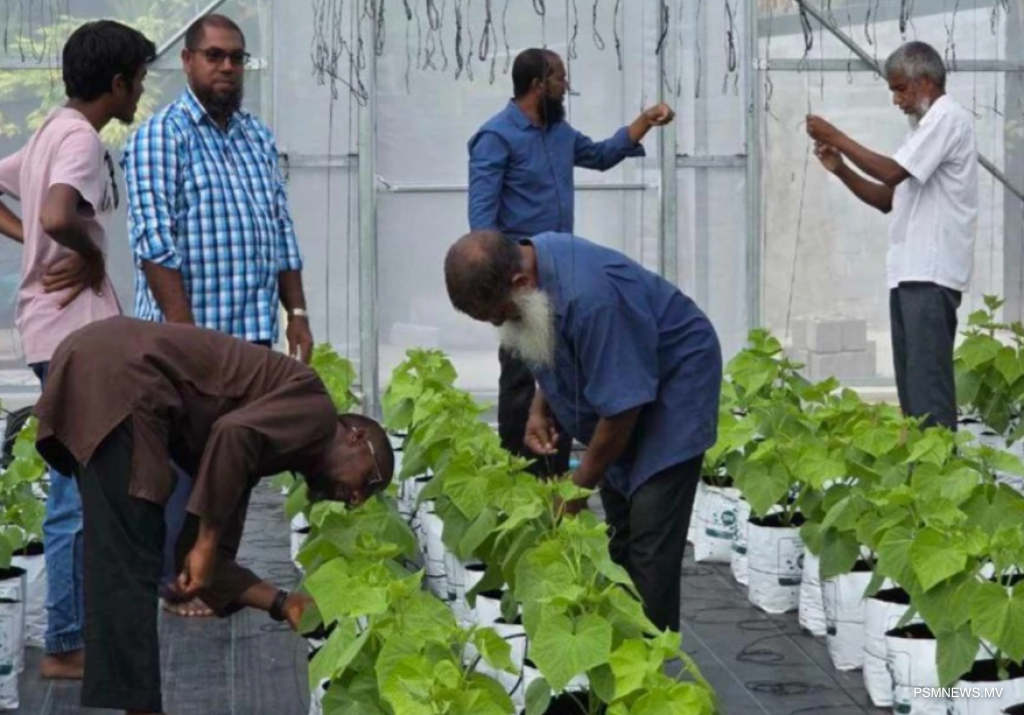
The Maldives is intensifying efforts to reduce reliance on imported fruits and vegetables through a comprehensive strategy aimed at achieving national food self-sufficiency.
President Mohamed Muizzu, in his Presidential Address at the opening of Parliament on 5 February, underscored agriculture as a cornerstone of sustainable development. He criticised previous administrations for underprioritising the sector and emphasised the need to reposition domestic food production as a national priority.
Under the leadership of the Ministry of Agriculture and Animal Welfare, modern farming systems have been rapidly deployed across the country. Hydroponic facilities have been established on ten islands, while greenhouse infrastructure has been developed across twelve islands in the northern region.
A total of 478 farmers have completed specialised agricultural training programmes. At the Hanimaadhoo Agriculture Centre, capacity has been expanded with the installation of three vertical hydroponic systems designed to enhance yield efficiency and optimise land use.
Progress has also been recorded in agricultural regulation and value addition. Ten farmers from Goidhoo recently received certification under the Maldives Good Agricultural Practices (MGAP) framework, marking the first time certification has been awarded following completion of all five programme modules. A value-addition facility has also been constructed in Goidhoo under a regional initiative supporting small-scale farmers across the SAARC region.
Financial support remains a central pillar of the strategy. The government introduced the ‘Dhanduveri Manfa’ matching grant programme, valued at USD 979,247.74, to assist farmers in establishing greenhouses and adopting modern cultivation techniques.
To strengthen market access, a dedicated Ramadan market was launched, supported by supply vessels transporting agricultural produce directly from the islands to consumers.
Collectively, these measures form part of a broader national policy mandating the localised production of key food staples in volumes sufficient to sustain the population. The government has also invited private sector participation through public-private partnerships to accelerate investment and innovation within the agricultural sector.
Government advances ambitious plan for agricultural self-sufficiency

Fetched On
Last Updated
Last Updated


