

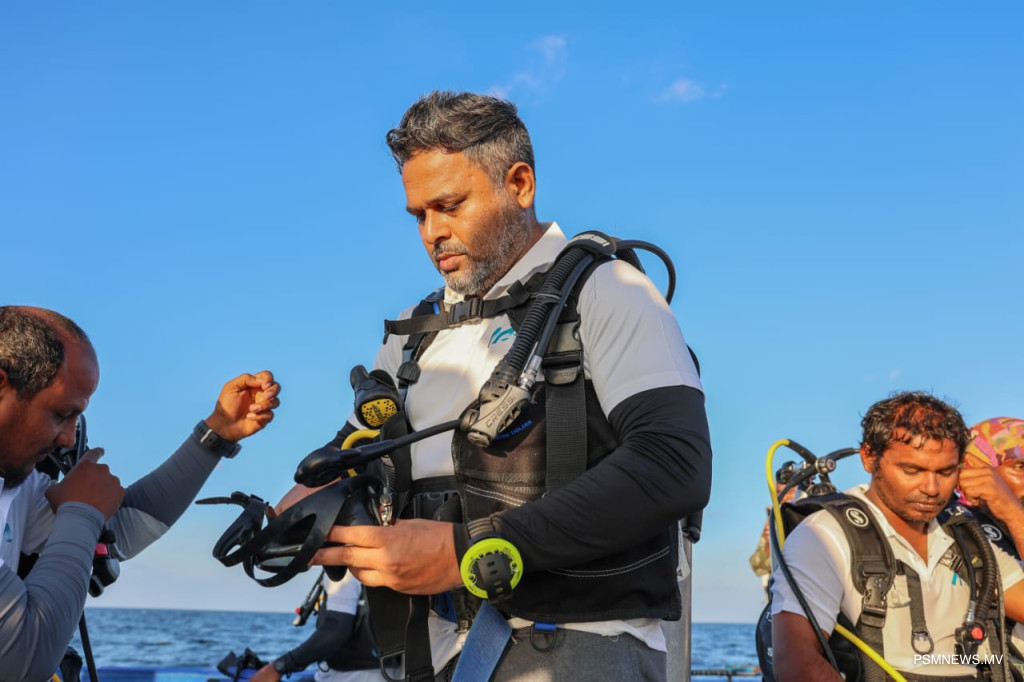
Minister of Fisheries, Agriculture and Ocean Resources, Ahmed Shiyam, has called for increased marine research, the identification of deep-sea resources and the exploration of sustainable avenues for economic diversification. He made the remarks in a special message issued to mark World Oceans Day.
Ocean Resources Minister Shiyam noted that more than 99% of the Maldives consists of the ocean, making it the country’s most important natural resource and the foundation of its economy. He said the ocean and its surrounding environment serve as the primary source of food, livelihoods and income generation for the Maldivian people.
He stressed that protecting and sustainably managing marine ecosystems and biodiversity is a responsibility shared by all citizens in order to preserve these resources for future generations.
The minister said that increasing self-sufficiency, ensuring food security and diversifying the economy can no longer be delayed in a rapidly changing global environment. He noted that these priorities have become even more important in light of the economic challenges arising from geopolitical tensions in the Middle East and ongoing uncertainty in the global economy.
According to the minister, the Maldives must continue to innovate and identify ways to maximise economic returns from its greatest asset, the ocean. The minister also highlighted the growing impact of climate change on the country’s fisheries sector. He said productivity across the Indian Ocean, including Maldivian waters, declined in 2024, resulting in a significant reduction in skipjack tuna catches.
The ocean resources minister explained that rising sea temperatures linked to climate change are causing tuna species to migrate to more distant areas and deeper waters. As a result, traditional surface fishing methods such as pole-and-line and handline fishing have been adversely affected. He added that the industry has experienced prolonged low-fishing seasons, creating challenges for fishers and the wider fisheries sector.
Furthermore, the minister said the long-term objective is to advance ocean research, identify deep-sea species and discover sustainable methods of diversifying the national economy. He stated that these efforts are aligned with the policies of President Dr Mohamed Muizzu’s administration, which aims to add greater value to fish catches, expand aquaculture activities and maximise benefits derived from marine resources.
Highlighting progress already made, the minister noted that seaweed farming was introduced to the Maldives last year and that the country successfully exported its first seaweed shipment this year.
Following the success of the initiative, two additional companies have invested in the sector and commenced operations.
The minister also revealed that a new project to manufacture products from seaweed has been developed and approved with technical assistance from the Food and Agriculture Organisation. He said the project is expected to create employment opportunities in islands across the country while opening new opportunities to utilise marine resources more effectively.
In addition, the minister said discussions are currently underway with the Government of Japan on a separate initiative aimed at maximising the economic benefits of the Maldives’ marine resources. He further noted that the current period coincides with the UN Decade of Ocean Science for Sustainable Development, commonly known as the Ocean Decade.
He explained that the global initiative seeks to strengthen scientific knowledge and data collection for ocean conservation through research on oceans, lagoons and coral reefs, while also building local expertise, developing new technologies and collecting information from stakeholders who depend on marine resources.
Concluding his message, the minister expressed hope that Maldivians would take a leading role in researching the country’s rich marine environment and in developing innovative ways to utilise ocean resources to support economic diversification and sustainable development.
Minister Shiyam calls for deep-sea research and sustainable economic diversification

Fetched On
Last Updated
Last Updated


