

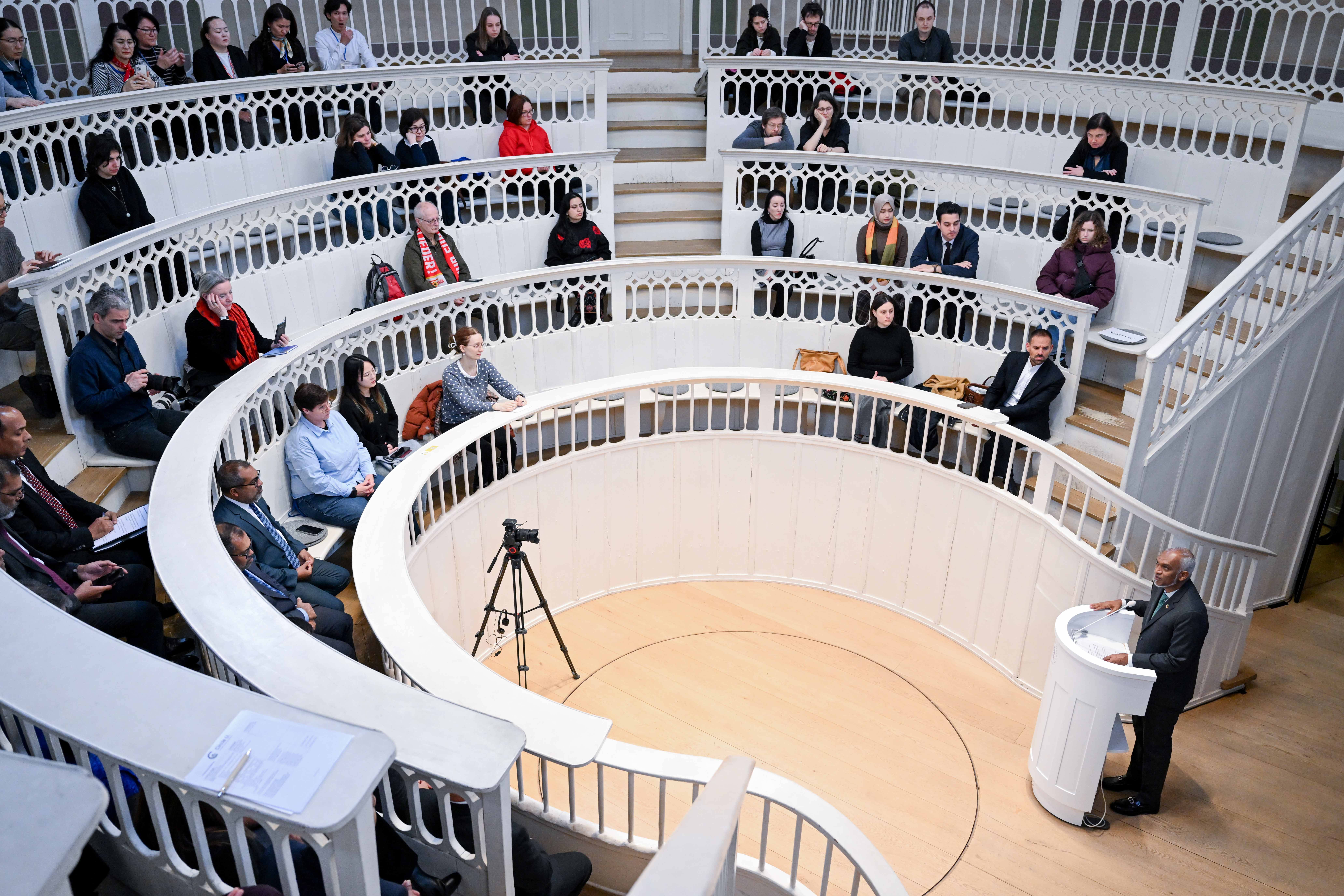
His Excellency President Dr Mohamed Muizzu visited Humboldt-Universität zu Berlin this afternoon as part of his ongoing official visit to Germany. The President was received by Dr Yoan Vilain, Vice-Provost for International and European Affairs, and Professor Dr Marcel Robischon, Head of the Division of Agricultural Ecology at Humboldt-Universität.
President Dr Muizzu delivered a keynote address during his visit. In his speech, he called for a fair and collective global response that aligns responsibility with support, noting that countries such as the Maldives contribute negligible amounts to greenhouse gas emissions yet are among the most severely affected by climate change. He emphasised that, for the Maldives, adaptation to climate change is not optional but a matter of survival and the protection of nationhood, culture and identity.
The President highlighted the need to integrate climate risk into national planning and budgeting, guided by climate science; to scale up finance mobilisation to deliver adaptation; and to ensure that adaptation efforts are inclusive and community-driven by strengthening local governance capacity. Describing adaptation financing as a matter of climate justice for those bearing the greatest risks, he underscored the importance of predictable, adequate and concessional climate finance for countries such as the Maldives.
Reflecting on lessons learned from the Maldives’ adaptation efforts, President Dr Muizzu noted that delaying adaptation only multiplies future costs, that communities are active agents of change, and that reefs, mangroves and other natural ecosystems remain among the most effective and affordable climate defences. He stressed that adaptation and development must go hand in hand.
Addressing the role of international partnerships grounded in science, the President observed that institutions such as Humboldt-Universität play a decisive role in shaping a collective response to climate change by bridging science and policymaking, amplifying vulnerable voices, training future experts and leaders, and safeguarding truth. He remarked that climate change without borders requires knowledge without borders and demands solutions that move beyond narrow national interests and short-term gain.
During the subsequent Q&A session, the President reiterated the role of academia in countering misinformation on climate-related issues and urged academic institutions to mobilise political support on multilateral platforms in pursuit of climate justice. He also spoke about sustainable tourism practices and energy transition efforts in the Maldives, and encouraged continued collaboration among Small Island Developing States (SIDS), alongside increased mitigation and adaptation support from major emitters for countries most vulnerable to climate change.
President visits Humboldt-Universität zu Berlin

Fetched On
Last Updated
Last Updated


