

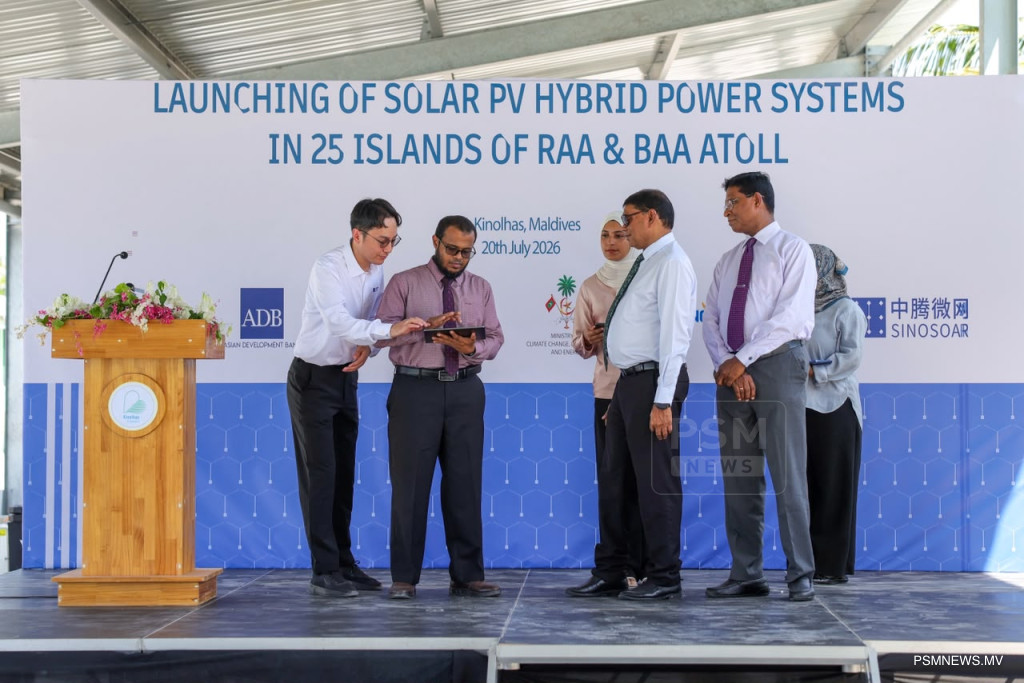
The Government of the Maldives, together with the Asian Development Bank (ADB) and the European Investment Bank (EIB), inaugurated a 6.4 megawatt (MW) solar photovoltaic‑hybrid electricity system on 25 islands in Raa and Baa atolls during a ceremony held in Kinolhas, Raa Atoll.
The event, presided over by Minister of Climate Change, Environment and Energy Ali Shareef, marks a pivotal advance in the nation’s Preparing Outer Islands for Sustainable Energy Development (POISED) project, aimed at bolstering energy security, curbing costly diesel imports, and meeting climate targets.
Attending the launch were Fenaka Corporation Managing Director Mohamed Afeef Hussain, Public Service Media Managing Director Ahmed Shakeeb, officials from the Ministry of Finance and Public Enterprises, and representatives of the Kinolhas Council.
Minister of State for Climate Change, Environment and Energy Dr Muaviath Mohamed highlighted the economic and environmental benefits of the initiative, noting that the new systems will generate an estimated 10.4 gigawatt‑hours of clean electricity each year—saving more than three million litres of diesel and cutting carbon‑dioxide emissions by roughly 8,400 metric tonnes annually.
“The shift to solar reduces our fuel bill year after year, easing pressure on the national budget and strengthening the Maldivian economy,” Dr Muaviath said.
He added that the rollout will begin in selected areas this year and expand to additional islands in the coming years.
Technical specifications of the inaugurated installations include 6.36 MW of peak solar PV capacity paired with a 10 MW battery energy‑storage system (BESS). Under the broader POISED framework, a total of 160 islands are slated to receive solar‑hybrid systems, delivering 19.8 MW of solar PV and 20.6 MW of battery storage. Currently, 23 islands are under construction and expected to be completed by 2027. To date, 72 islands have already been converted, housing 13.4 MW of solar PV and 10.6 MW of BESS, alongside upgraded grids, energy‑management systems, and a supplemental 27 MW diesel generator for backup.
The POISED project aligns with the Maldives’ national ambition to source 33 percent of its electricity from renewables by 2028—a target also reflected in the country’s Nationally Determined Contribution (NDC) under the Paris Agreement.
Maldives launches solar‑PV hybrid systems across 25 islands

Fetched On
Last Updated
Last Updated


