
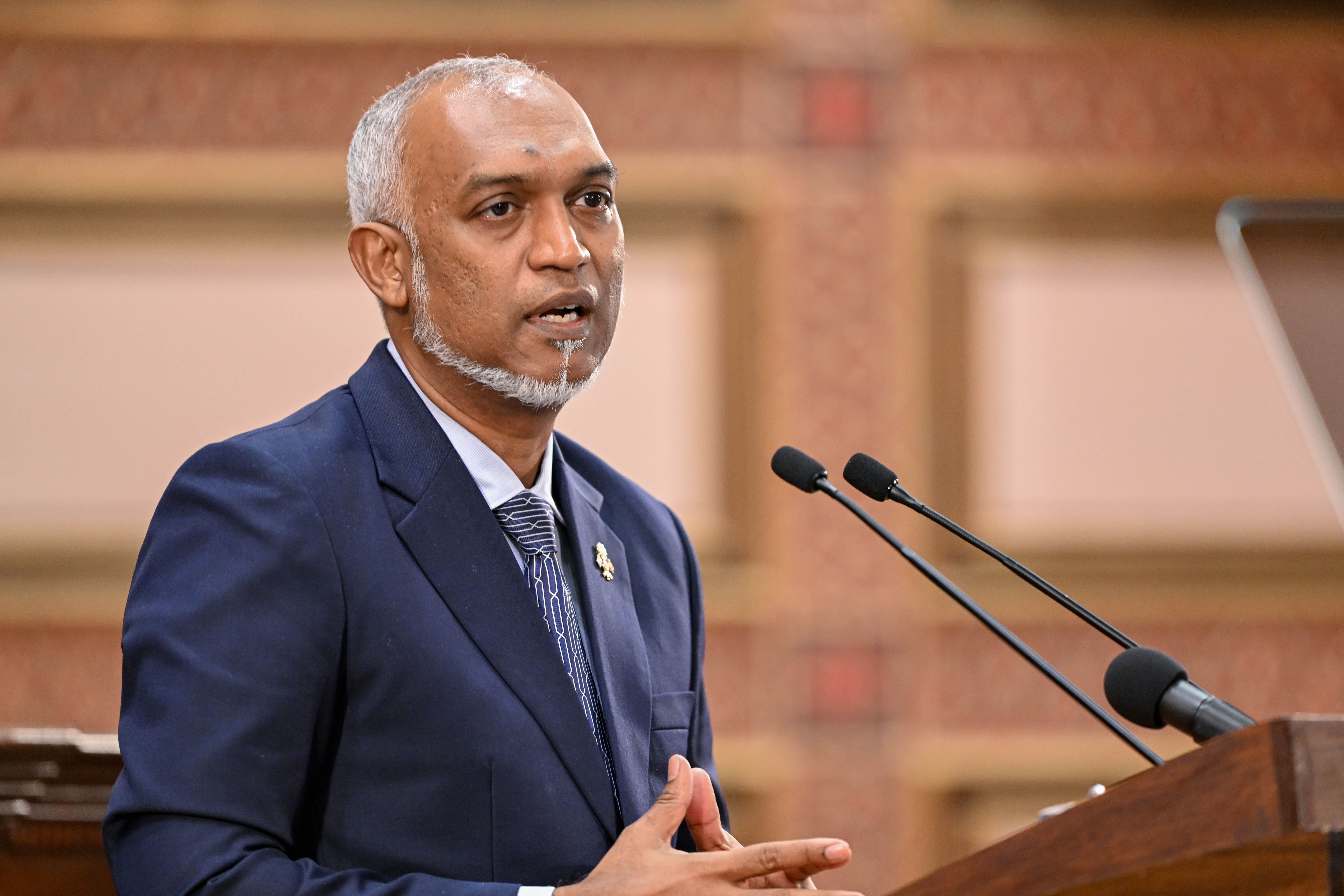
President Dr Mohamed Muizzu has stated that the Administration is implementing a dual-track strategy to address the drug crisis while strengthening youth empowerment, as part of wider efforts to ensure national peace, stability, and public safety.
The President made these remarks this morning whilst delivering the Presidential Address at the first sitting of the first session of the 20th People's Majlis for the year.
He emphasised that tackling organised crime and gang activity – both directly and indirectly linked to drug trafficking – is critical to safeguarding national security. The President noted that since the enactment of relevant legislation, gang-related activity has declined, with many young people formerly involved now seeking to disengage. He stated that the Government welcomes these individuals and is committed to supporting their reintegration as responsible and productive members of society.
Outlining progress in disrupting drug supply networks, the President said narcotics seized through enforcement operations have a combined street value of MVR 2.3 billion. He added that the volume of drugs confiscated over the past two years represents the highest recorded during the first two years of any administration across the past three terms.
Highlighting the importance of rehabilitation, the President said establishing a robust system for treatment and reintegration of drug-dependent individuals remains a priority. He announced that comprehensive Islamic education will be formally incorporated into rehabilitation programmes, noting that religious guidance has not previously been included in a structured manner. In this regard, the Ministry of Islamic Affairs will commence the Risaalath programme for individuals undergoing treatment from May this year.
The President further announced a landmark decision to develop a rehabilitation-focused island based on the Open Prison Island concept – the first initiative of its kind in the Maldives. Under this model, an entire island will function as a correctional and rehabilitation facility where inmates can live and work. The project has been mandated to the Maldives Correctional Service, with infrastructure development expected to begin by mid-year and the first group of inmates scheduled for transfer by the end of the year.
Turning to youth empowerment, the President stated that protecting children and young people from narcotics, violence, gang-related crime, and other harmful influences is a fundamental responsibility of the State. He stressed that the country’s future depends on the guidance and opportunities provided to today’s youth. As part of these efforts, he highlighted the launch of the Dhivehi National Movement Training Programme to address long-standing gaps in youth development and build a resilient generation. He noted that 344 participants from the first batch graduated on 28 December 2025, with training for the second batch currently under way.
The President also outlined ongoing initiatives to empower young people through the establishment of Youth Hubs, aimed at nurturing talent in the arts and entertainment, strengthening civil society organisations, and promoting reading and lifelong learning. He noted that many young people are already benefiting from programmes delivered through these facilities.
Additional youth-focused initiatives highlighted in the Address include the expansion of technical and vocational training, the convening of a National Youth Conference, and the establishment of a Youth Parliament with representation from diverse sectors and islands across the country. The President further stated that steps will be taken to integrate youth perspectives into ministerial work, while reintegration and religious awareness programmes will continue to prevent criminal involvement and counter extremism among young people.
Presidential Address 2026: President outlines dual-track strategy for drug reform and youth empowerment

Fetched On
Last Updated
Last Updated


