

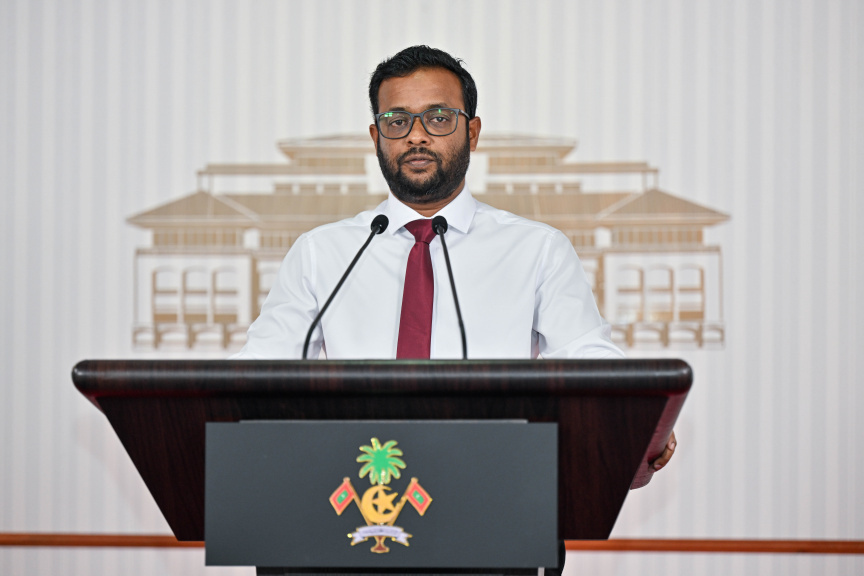
The Ailee Boahiyavahikan Program intentionally prioritizes families without a home or a land plot over others, says Housing Minister Dr. Abdulla Muthalib, explaining why he believes the incumbent administration’s new housing scheme is not only fair, but necessary to address the country’s housing crisis.
The Housing Ministry opened applications for the Ailee Boahiyavahikan Program earlier this month, offering 15,000 land plots and 7,900 flats from the greater Male’ area.
In a detailed LinkedIn post on Sunday, Muthalib acknowledged concerns and questions about the eligibility criteria for the program, and explained the rationale behind the government’s new housing policy.
He began by clarifying that families where the applicant or the spouse owns a one-bedroom or two-bedroom apartment may still apply if they have children under 18.
He also acknowledged concerns over situations where an applicant’s spouse holds a land plot larger than 400 square feet in Male’ region, but stressed that while these questions are valid, prioritizing families with no home or land plot at all is not only fair, but necessary.
“Public housing policy exists for one reason: to ensure no family is left without a basic foundation for dignity and stability. Housing is not a bonus to be optimized. It is the starting point for everything else, education, health, employment, and social cohesion,” he wrote.
Muthalib said that when a family has no home and no land, their vulnerability is absolute. Whereas when a family has some form of housing access, even if limited or shared, their situation, while still challenging, is fundamentally different.
He said that public policy must recognize that difference.
“The Aailee Boahiyavahikan Program is guided by a simple and just principle: Those with nothing must be prioritized before those with something. This is not a moral judgement. It is not a statement about deservingness. It is about preventing the deepest form of housing insecurity first,” he wrote.
Hulhumale' Phase III land reclamation in progress on November 10, 2025. (Photo/President's Office)
Muthalib stressed that a family with no family or land has no fallback option, no long-term security, and no buffer against rising costs or displacement.
“A family where one spouse owns a home or land—regardless of size—has some level of security, even if imperfect. When resources are limited, prioritization is not discrimination. It is responsibility,” he wrote.
Muthalib said that the eligibility rules are not permanent barriers, but exist because housing supply is still catching up with demand.
He expects the pressure on public housing to ease with the issuance social housing units land plots, affordable ownership schemes, and private-sector housing.
“When every family has access to at least one home or land plot, the policy will evolve,” he wrote. “At that stage guidelines will be relaxed, eligibility will widen, and additional opportunities will be created. But fairness requires that no family is left without a first home while others receive a second.”
Muthalib said that the new scheme is called ‘Aailee Boahiyavahikan’, which translates to family housing, because housing insecurity affects families, not individuals in isolation.
“Families carry children, elderly parents, dependents, and shared responsibilities. Public housing must therefore prioritize households where instability has the widest social impact,” he wrote.
“This is not about exclusion. It is about protecting those at greatest risk first.”
Muthalib said that the core principle guiding the scheme is that public housing must first ensure that every family has somewhere to stand.
“Once that foundation is secured, opportunity can expand. This is how we ensure that Housing for All truly means all—starting with those who have none,” he wrote.
Applications for the Aailee Boahiyavahikan Program must be submitted via a dedicated digital portal. Applications for land plots closes at 11:59 pm on March 5, while applications for flats close at 11:59 pm on April 18.
The scheme offers 7,900 flats from the greater Male’ region and 15,000 plots of 1,250 square feet from the greater Male’ region and Rasmale’. The land scheme is divided into two categories. Registered residents of Male’ and other priority category applicants will receive land from greater Male’ and Rasmale’, while people from other islands who reside in Male’ will receive land from Rasmale’.
Minister: New housing scheme prioritizes families without a home, others come after

Fetched On
Last Updated
Last Updated


