

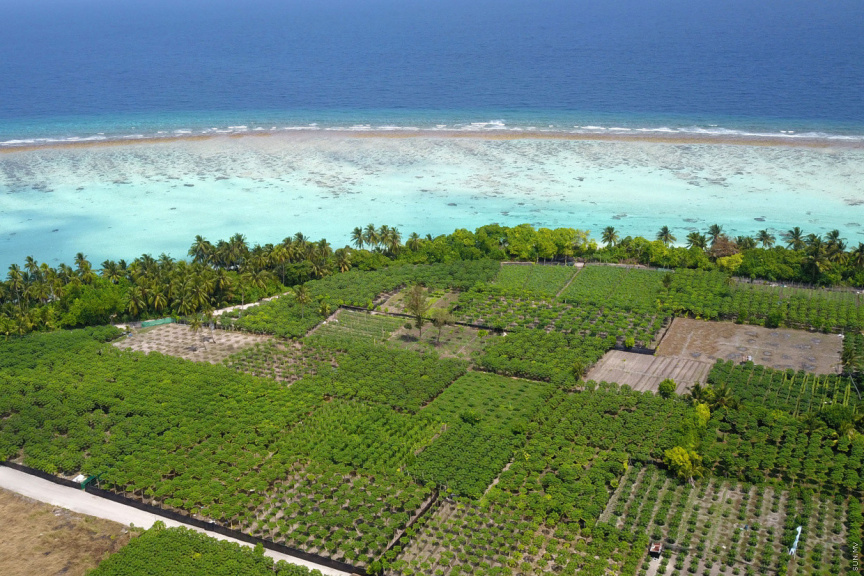
Farmers in Thoddoo and Kandoodhoo, the country’s two main agricultural islands, say their fields are in far better condition this year, with yields expected to improve ahead of Ramadan.
Last Ramadan was one of the most difficult seasons in recent years. Many farmers reported that their fields were not profitable, with some unable to recover basic expenses. Heavy rains damaged several farms, and both agricultural and market businesses saw steep declines. Daily earnings that typically reached MVR 30,000 fell to MVR 4,000 for some traders.
With Ramadan now approaching, Thoddoo councillor and farmer Aishath Junaidha said most fields on the island are in good condition. However, she noted that some watermelon plots continue to face disease issues, and blight has not been fully resolved.
She added that the rising cost of pesticides remains a major burden for farmers.
A watermelon farm in AA. Thoddoo. (Photo/Twitter)
Despite these challenges, Junaidha expects incomes to improve during Ramadan, especially with increased demand for vegetables such as cucumbers.
“We are hopeful the income from the fields will be good. Thoddoo people are working hard to prepare for the month of Ramadan,” she said.
Thoddoo is the country’s leading producer of watermelons, while Kandoodhoo is renowned for its chilli peppers, particularly the dark Maldivian scotch bonnets that dominate local markets.
Kandoodhoo Council President Ahmed Reehan said farmers on the island are also preparing intensively for Ramadan. He expects the island to export around two tonnes of chilli per day during the season.
A chilli field in Thaa atoll Kandoodhoo; the island's chilli is one of the top commodities for local consumers during Ramadan -- Sun Photo/ Mohamed Naail Hafeez
Reehan, who raised concerns about pesticide prices last September during a meeting attended by President Mohamed Muizzu, reiterated that the rising cost and limited availability of pesticides continue to hurt farmers. He also criticised the import of cheaper, locally‑grown pesticides by traders and government entities, saying it undermines island producers.
According to Reehan, 90 percent of Kandoodhoo residents earn their income from pepper fields.
Both Junaidha and Reehan said last year’s losses were driven largely by the weakened economy and a lack of buyers in the market, issues that many fear could resurface as prices rise ahead of Ramadan.
Thoddoo and Kandoodhoo farmers expect stronger yields as Ramadan approaches

Fetched On
Last Updated
Last Updated


