

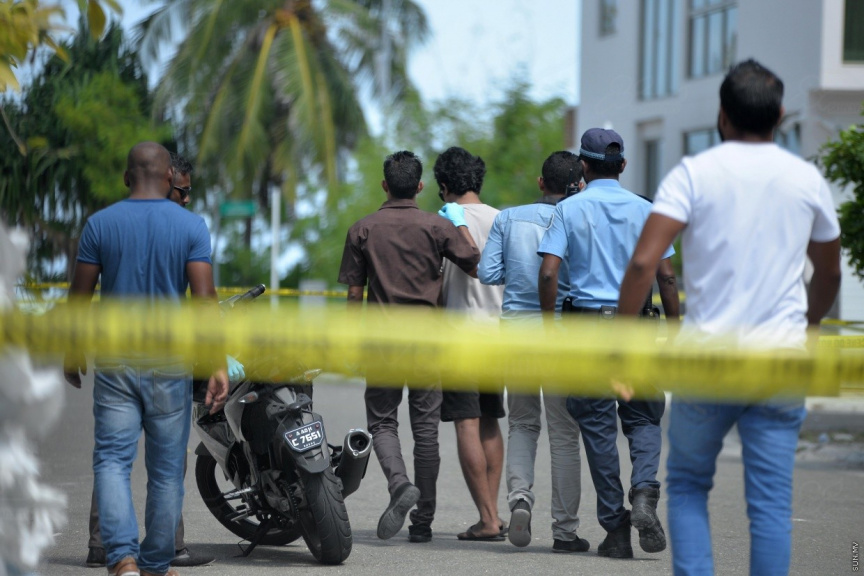
A staggering 41 percent of crimes reported this year to police stations in the Maldivian capital involved theft, according to information shared by the police.
At a press conference on Tuesday morning by Male’ police, Head of Male’ Frontline Policing, Superintendent of Police Abdulla Rasheed said that theft is the most frequently reported type of crime in Male’.
He said that these cases involve some 1,000 individuals who are repeat offenders.
“Around 1,000 individuals are involved in all these thefts. The other thefts are crimes of opportunity. The most frequently reported type of theft is the theft of motorcycles,” said Abdulla Rasheed.
According to Abdulla Rasheed, 67 percent of all theft cases involve stolen motorcycles.
He said that most motorcycle thefts result from people forgetting to lock the shutter lock on their vehicles, which allows thieves to steal it by using a different key.
Head of Male’ Frontline Policing, Superintendent of Police Abdulla Rasheed. (Photo/Maldives Police Service)
Abdulla Rasheed said that the repeat offenders include someone who was arrested 128 times and questioned 1,012 times this year alone, and another individual who was arrested 50 times and questioned 586 times.
Theft and drug abuse – the former of which is often connected to the latter – are also among the most common cases for remand hearings at the Criminal Court.
On Sunday, Judge Safath Habeeb heard a case regarding a 46-year-old man who was arrested from Maldives Polytechnic – a college located in Male’. The suspect claimed he had just been hiding inside the store room, but the police believe he went in there to steal.
At the hearing, the judge noted that the suspect had an “unusually lengthy” record for theft, and also confessed to being a drug addict.
He expressed concern over the high rate of recidivism in the Maldives, and suggested it may be a systemic issue with the existing penal system.
“While the core purpose of the penal system is to rehabilitate individuals, the current system is not producing effective results. This requires a systemic change,” he said.
Theft accounts for 41% of crimes in Male’; involve 1,000 repeat offenders

Fetched On
Last Updated
Last Updated


