

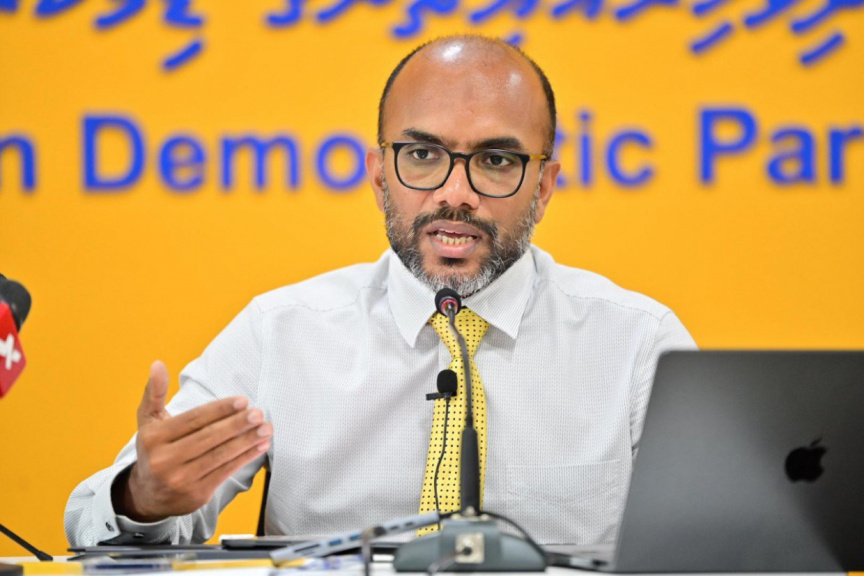
Former finance minister Ibrahim Ameer has accused President Dr. Mohamed Muizzu’s administration of attempting to channel borrowing through a State-Owned Enterprise in order to hide the true cost of refinancing the USD 500 sukuk that’s due in April.
The Maldives has a staggering USD 1.1 billion in debt repayments due this year, including a USD 500 million sukuk and another USD 100 million payment due in April.
There are reports that the government is close to finalizing a USD 300 million loan from US-based Cargill Financial Services International at a 14 percent interest rate to help refinance the sukuk.
But in his annual address on February 5, President Muizzu assured the Parliament that the new borrowing to refinance the sukuk will not exceed 9 percent interest, and that unlike what the previous administration did, the sukuk will be refinanced in a way that reduces the burden and restores debt stability.
In a post on X on Thursday, Ameer said that despite President Muizzu’s assurance, the recent credit downgrades have reportedly pushed Maldives’ sovereignty risk to around 14 percent, making refinancing below 9 percent through normal channels unlikely without concessional financing.
Ameer believes it likely that instead of borrowing directly at 14 percent, the government has an SOE – most likely the Bank of Maldives (BML) – borrow from Cargill at 14 percent and then on-lend it to the government at a lower headline rate, which could be 9 percent.
If the true cost of refinancing the sukuk is 14%, it should be acknowledged transparently. Channeling borrowing through an SOE does not reduce the burden; it shifts and obscures it, potentially weakening the financial system in the process. The public and investors deserve full… pic.twitter.com/ZuZE0aEzXp
— Ibrahim Ameer ???????? (@iameeru) February 12, 2026
The former finance minister warned that in such a structure, the true system cost remains 14 percent, and the lower rate becomes cosmetic, as the risk shifts to the balance sheet of an SOE.
He added that the move will lead to the banking system carrying concentrated sovereign exposure and contingent liabilities rising.
“This is not debt relief. The cost of debt has not fallen, it has risen. And the risk to the system has increased,” he wrote.
He urged the government to transparently acknowledge it if the true cost of refinancing the sukuk is 14 percent.
“If the true funding cost is 14%, it should be acknowledged as 14%. Channeling borrowing through an SOE does not reduce the burden; it simply shifts the risk, potentially into BML’s balance sheet,” he wrote.
Ameer said the potential move raises concerns about BML’s financial strength, liquidity and independence.
“A commercial bank should not be used to absorb sovereign refinancing risk,” he wrote. “The public deserves full transparency on the structure of the real plan for sukuk refinancing.”
President Dr. Mohamed Muizzu (L) and Finance Minister Moosa Zameer (R). (Photo/President's Office)
In his annual address, President Muizzu said that USD 150 million out of the USD 500 sukuk that is due in April will be paid through the Sovereign Development Fund (SDF).
Meanwhile, Finance Minister Moosa Zameer has said that the sukuk will be refinanced in a well-planned manner that restores debt stability.
The government has repeatedly expressed confidence in its ability to repay the massive debt.
Citing default risks, Moody’s has downgraded Maldives’ credit rating from CAA1 to CAA2, while Fitch downgraded the country’s credit rating from CCC+ to CC.
The World Bank has warned the situation makes it harder for the Maldives to secure foreign assistance to alleviate the crisis it faces.
Ameer: Govt channeling loan through SOE to hide true cost of refinancing sukuk

Fetched On
Last Updated
Last Updated


