

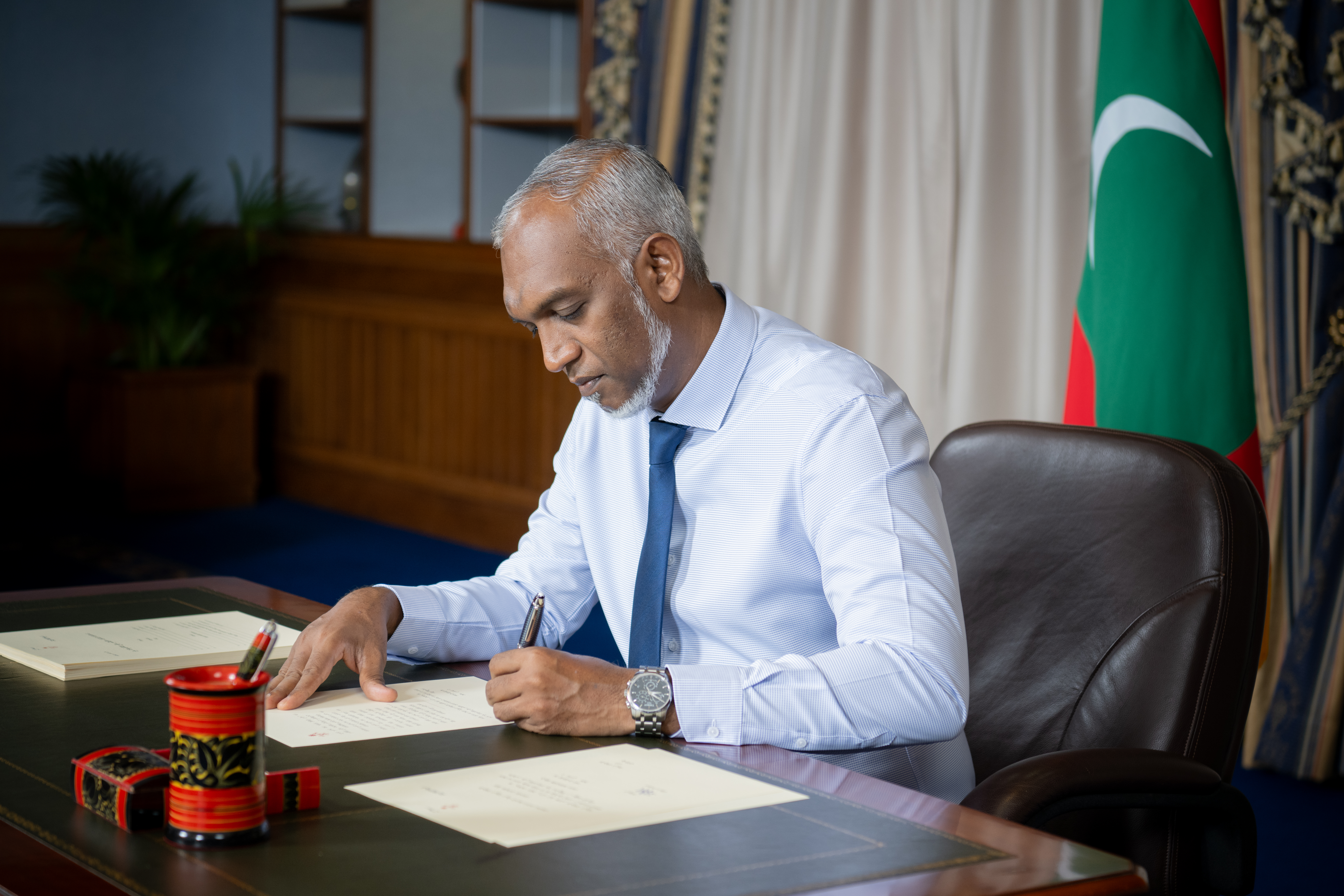
President Dr Mohamed Muizzu has ratified the Third Amendment to the Drugs Act (Act No. 17/2011).
The Amendment was passed by the 20th People’s Majlis during the 28th sitting of its third session for the year, held on Wednesday, 3 December 2025.
The reforms introduced under the Amendment include the establishment of a system to regulate newly emerging substances in addition to those already controlled under the law, the creation of new drug-related offences and corresponding penalties, and the enhancement of the treatment framework for individuals with addiction.
The Amendment further revises the operational rules of the Drug Court and its treatment programmes. In addition, it grants strengthened powers to law enforcement agencies to prevent drug-related crimes, updates procedures governing the seizure and confiscation of assets obtained through criminal activity and introduces a series of further measures designed to reinforce overall law enforcement efforts.
A significant amendment introduced to the Bill is the substantial increase in penalties for drug trafficking offences, including attempting to import or export, assisting in the import or export, or otherwise participating in the import or export of drugs listed in Schedule 1 of the Act. The penalty for such offences has been increased to 20 years’ imprisonment and a fine ranging from MVR 75,000 to MVR 7,500,000.
The Amendment further provides that the penalty for trafficking a Schedule 1 drug may be elevated to the death penalty where specific conditions are met. These conditions include situations where the quantity of drugs trafficked into the Maldives exceeds 350 grams of cannabis, 250 grams of diamorphine, or 100 grams of any other Schedule 1 drug, and where the individual brings the substance into the country at the time of entry.
Where a person is sentenced to the death penalty, the Amendment requires that all legal aspects of the conviction and the circumstances of the case be reviewed by a superior court, and that the sentence may only be executed with the where every justice of the Supreme Court, sitting as a full bench, unanimously agrees.
The Amendment also stipulates that offences carrying penalties of life imprisonment or the death penalty shall not be eligible for clemency under any circumstance. Furthermore, individuals accused of such offences are not eligible for plea agreements as defined under Criminal Procedure Code (Act No. 12/2016).
In addition, the bill introduces several new drug-related offences, including the provision of services that facilitate drug use, and holding owners, tenants, occupants, caretakers, or any persons in charge of premises liable where they know or have reasonable cause to believe that such premises are being used for drug consumption. The bill further criminalises the financing of the drug trade. It also grants the police authority to seize and confiscate vehicles and vessels used for drug trafficking and to close down establishments that provide or enable drug-related services.
The Amendment will come into effect three months after its ratification and publication in the Government Gazette.
President ratifies the Third Amendment to the Drugs Act

Fetched On
Last Updated
Last Updated


