
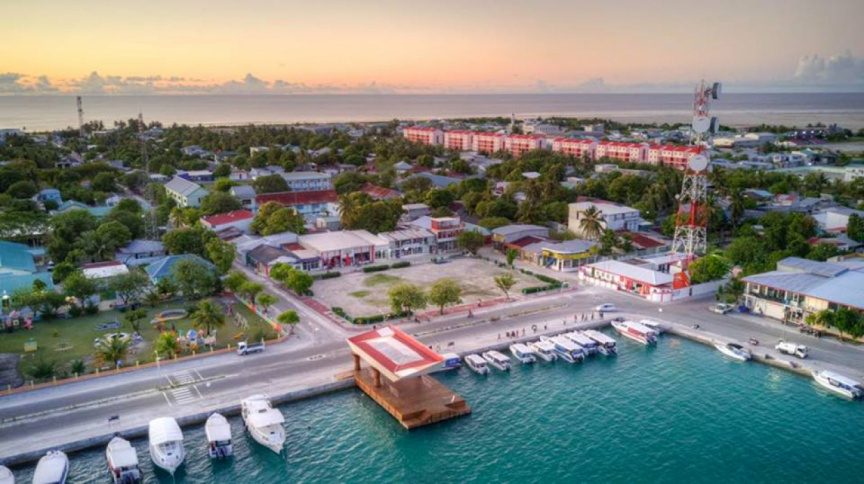
A complaint has been filed with the Elections Commission (EC) alleging Thinaadhoo City’s electoral constituencies for the upcoming local council elections was determined based on the fraudulent population list leveraged to falsely gain city status for GDh. Thinadhoo.
Thinadhoo was designated as a city on August 30, 2023, by then-president Ibrahim Mohamed Solih during the 2023 presidential campaign. The incumbent administration decided it would not revise the decision.
A Thinadhoo resident, in a letter addressed to EC president Mohamed Zahid, said Thinadhoo was granted city status in August 2023 based on a list by Thinadhoo Council which falsely stated that the island’s population stood at 10,150. The resident emphasized the discrepancies in the population list maintained by the Thinadhoo Council and the Department of National Registration (DNR), with the latter declaring the population of Thinadhoo as less than 8,000.
In this regard, the resident detailed that it was uncovered that Thinadhoo Council has boosted the population of Thinadhoo by including names of deceased, individuals removed themselves from the island’s registry decades back, individuals from other islands who have never been registered to Thinadhoo and repeating names of people by registering them to two different houses or slightly altering their ID card numbers.
The resident added that police are investigating the alleged misrepresentation of Thinadhoo’s actual population and the submission of false information to government authorities, noting that many Thinadhoo residents have already provided statements for the case.
Despite this, the resident said that the electoral constituencies in Thinadhoo for the upcoming local council election were determined based on a fraudulent list by Thinadhoo Council declaring the island’s population as 10,453.
The resident affirmed that Thinadhoo’s registered population will not reach this amount, backing the argument with statistics from DNR. In this trajectory, the resident said Thinadhoo's registered population stood at 8,194 as of November 6th, accounting for 4,126 males and 4,068 females.
As such, the resident said the population reviewed by the EC includes around 2,200 people who are not actually registered in Thinadhoo. As a result, the resident emphasized that the electoral constituencies were determined using a population list containing false information.
The resident noted that if Thinadhoo residents were to vote based on the current list, some individuals might end up having to vote in two constituencies — something the resident said applies to themself as well.
“If voting is carried out based on the current list, there is the threat of a single person could end up having to vote at two different ballot boxes on two different constituencies (what has happened to me), a dead person having to get up from their burial grounds to vote, and individuals who does not exist in human form having to vote,” the letter read.
The resident pointed out recent changes to the Decentralization Act which stipulates the number of island or city council members will be determined based on the population of the respective population of the island or the city.
Under the new amendment, islands with fewer than 2,000 people will be represented by a three-member council that includes one woman, while islands with 2,000 or more residents will have a five-member council with two women councilors. Meanwhile, cities with a population ranging between 10,000 to 25,000 will be represented by a seven-member council, while cities with a population ranging between 25,000 to 50,000 will be represented by an 11-member council.
The resident expressed their belief that the number of councilors and electoral constituencies should not be determined without cross-checking population lists sent by councils with DNR records.
In this context, the resident, citing every island would desire to have as many councilors as possible, expressed concern regarding the possibility of other islands or cities taking example from Thinadhoo Council to inflate their population in order to pave the way for more councilors and stand entitled to higher block grants.
As such, the resident urged EC to determine the electoral constituencies of Thinadhoo by referring to DNR records rather than the Thinadhoo Council’s fraudulent list.
An island is legally required to have a population of over 10,000 people to be designated as a city.
Notably, former magistrate Ahmed Raghib lodged a constitutional case with the High Court in November of last year, citing Thinadhoo was designed a city in violation of laws: a petition which was rejected. Raghib had been serving as a deputy minister for environment at the time but was subsequently dismissed.
The issue of Thinadhoo’s city status has also been raised by North Thinadhoo MP Saudhulla Hilmy with the Local Government Authority (LGA) and the Parliament.
Complaint alleging Thinadhoo constituencies determined based on forged list

Fetched On
Last Updated
Last Updated


