

Maldivians have always been keen on experiencing new things. This sentiment is reinforced by the sudden shifts in the political landscape, brought about by the strong winds of democracy that reached the Maldives from the West.
Research consistently highlights a fundamental human truth: most people are naturally inclined to seek out new experiences. This explains why many find it easy to trust any new narrative presented to them: a reality that has become a powerful tool for politicians. When it comes to electing individuals to public office, it is often the politicians who define the reasons why a particular person should be elected, shaping the public's perception of what needs to be achieved.
However, amidst the various deceptions used for political gain, there is a growing confusion regarding the mandates of the three branches of state and the specific responsibilities of elected officials. As the Maldives approaches elections to determine the composition of local councils for the next five years, conflicting narratives are emerging. People are discussing the duties of councils and councillors in vastly different ways, leading to widespread misunderstanding. What, then, is the true nature of these responsibilities?
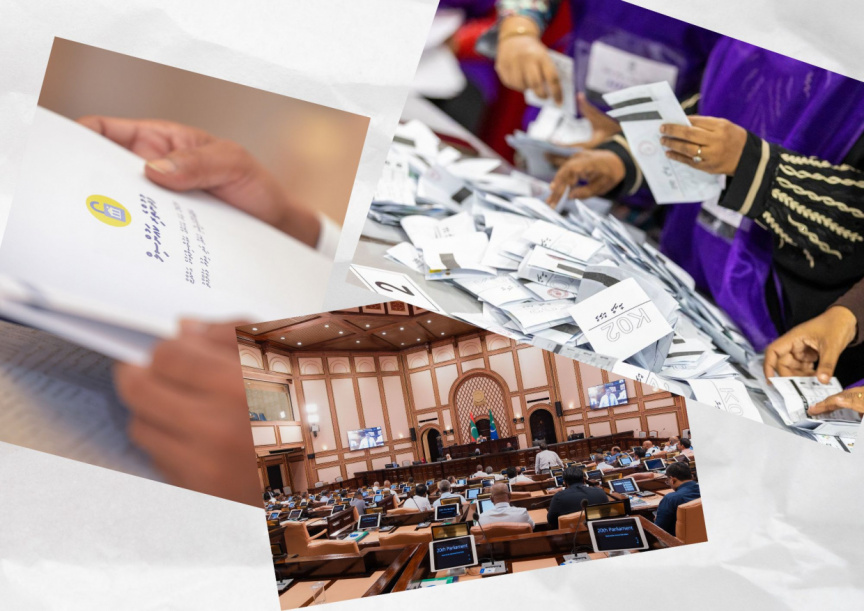
Voters cast their ballots in a polling station in Male' during the 2024 parliamentary elections on April 21, 2024. (Sun Photo/Moosa Nadheem)
The three branches of state in the Maldives: A blurred reality
A state is built upon three primary pillars: the Executive, the Legislative, and the Judiciary. In any functional democracy, these branches are organized to provide a system of checks and balances, ensuring that no single branch encroaches upon the domain of another.
The President stands as the head of the Executive. This branch is responsible for making major government decisions and implementing state policies—essentially, running the government. A President is granted significant powers not to act on whim, but to serve the public interest. Yet, one must wonder to what extent the transparency of presidential decisions and policies is truly evident in the Maldives.
Then there is the Parliament, locally known as the People's Majlis— the Legislative body. In the Maldives, the Majlis is often perceived as a "gift" bestowed upon a President who wins an election—a place reserved for members who are politcally aligned with the President. This pattern has been evident across the last three parliamentary assemblies. However, in a presidential system like ours, the Majlis is intended to be the sole institution tasked with holding the government accountable. It is the only platform where cabinet ministers can be summoned and questioned. Its role is to oversee every action of the Executive and to prevent any attempts at deception. If we hand the keys of the house to the very person intending to steal, what can we expect? This is where the public’s understanding of elected roles begins to falter.
The third pillar is the Judiciary, the primary authority for upholding justice. It must, by necessity, remain independent of political influence. Not even the shadow of a person with vested interests should fall upon the courts or the judges. Yet, what is the reality in the Maldives? When both the Executive and the Legislative bodies are handed to those who turn a blind eye to wrongs, allegations of "influencing" the judiciary inevitably surface.
The Justice Building located in the capital Male which houses several courts.. (Sun File Photo/Ihthishaam Mohamed)
Are we electing members to the Parliament to '"procure medicine for a prescription"?
The confusion over the role of elected officials truly deepens at the parliamentary level. In every election, the justification for electing certain members often boils down to gifting basic supplies like rice, sugar, and flour to households in the constituency. The perceived duty of a Member of Parliament (MP) has shifted towards personally chasing after the Health Minister to arrange doctor appointments for constituents. Matters have reached a point where even securing a job seems impossible without the involvement of an MP.
"In reality, this happens because candidates allow it. Isn't it common in the Maldives now for people to demand money when candidates come seeking votes? Many sell their votes for 500, 1,000, or 2,000 Maldivian Rufiyaa. For a wealthy candidate, this is a much easier path than trying to win an election based on policy," said an academic expert in good governance.
The lack of accountability from candidates, combined with lack of public knowledge on constitutional roles and lack of integrity, results in electing members who spend their time "running around" to fulfil personal requests for medicine, rather than serving in a parliament meant to hold the executive accountable. The true purpose of electing a legislature is lost. Instead of a parliament that challenges the government, the two merge, leaving no one to oversee the administration and allowing the executive branch to become an unchecked, "colossal" power.
Parliamentarians pictured during a sitting. (Photo/People's Majlis)
Are we electing councils to chase after the Government?
Next are the Local Councils. These are the representatives closest to the people, tasked with making decisions and setting policies that affect the daily lives of citizens. Every five years, residents of islands and cities elect their mayors, council presidents and councillors.
The Decentralization Act clearly outlines the responsibilities of island and city councils. They include providing municipal services in collaboration with local offices and formulating development plans. Nowhere does the law state that they are elected to "run after" or harass the central government. However, this remains a point of contention among some politicians.
Fayyaz Ismail, the former Chairperson of the main opposition party, MDP, stated during a mayoral primary campaign rally that the Mayor of Malé must be someone capable of keeping the government in "hot water" every day. This implies that the person elected to serve the residents of Malé should also take on the parliamentary responsibility of holding the state accountable.
"That [keeping the government in hot water] can only be done if we have "our" Mayor in Malé City. That Mayor must be someone who puts this administration into hot water every single day," Fayyaz said on the 4th of this month.
In contrast, Rozaina Adam, a senior member of the same party and the former representative for the Addu Meedhoo constituency, holds a very different view.
"To hold the government accountable? To run after President [Dr. Mohamed] Muizzu? No. We are not electing a Mayor to run after President Muizzu. We are not electing a Mayor to hold the government accountable either. Our Constitution clearly defines what roles, who have. Holding the government accountable is the responsibility of the People’s Majlis," Rozaina stated on the night of the 8th, just four days after Fayyaz’s comments.
Citing the Constitution, Rozaina further clarified that the Majlis is not an institution that must do whatever the government says; rather, it is where the government must be held accountable. Conversely, she argued that councils should be accountable to the government, as they receive their budgets from the state to provide services to the people.
Former MP Rozaina Adam speaks at Adam Azim's mayoral primary rally for MDP on January 8, 2026.
An expert in political science also agreed that it is a misguided idea for local councils to focus on pursuing the executive branch.
"A local council is not a political party. While they can work within their jurisdiction to ensure government accountability to some extent, they are elected to find the best outcomes for the people and must respect the separation of powers," the expert said.
He further explained that councils fall under the purview of the Ministry of Cities, Local Government and Public Works, and the Local Government Authority (LGA). Therefore, if an institution is required to be answerable to a government ministry, how can it simultaneously be the body that holds the entire government accountable?
President Dr. Mohamed Muizzu also concurs, viewing it as a mistake for councils to set themselves up as opposition to the government. He noted that if councils act against the government, it is the development of the island that ultimately stalls.
Thus, the widely accepted truth is that councils should exist to facilitate the lives of citizens and work towards the development of their respective islands or cities.
Informed citizens make better decisions
Power ultimately resides with the people. However, learning how to exercise that power and becoming well-informed is crucial to utilizing it effectively. The public’s influence over political leaders only grows as the citizens themselves become more aware. Even when adhering to a specific ideology, one should do so with enough critical thinking to understand the systemic realities. In future elections, votes should not be treated as commodities to be sold for a bit of cash. Similarly, people should not be elected for "show" or for purely political purposes to fulfil duties that do not even fall within their legal mandate.
Councilors attend 'Viyavathi' conference in 2022. (Photo/President's Office)
As long as we elect members based on their ability to secure jobs, and as long as we seek councillors to run political hubs rather than local administrations, we will remain entangled in this confusion over the true responsibilities of elected office.
Securing jobs via MPs, holding govt accountable through councils: A grave confusion of mandates

Fetched On
Last Updated
Last Updated

