
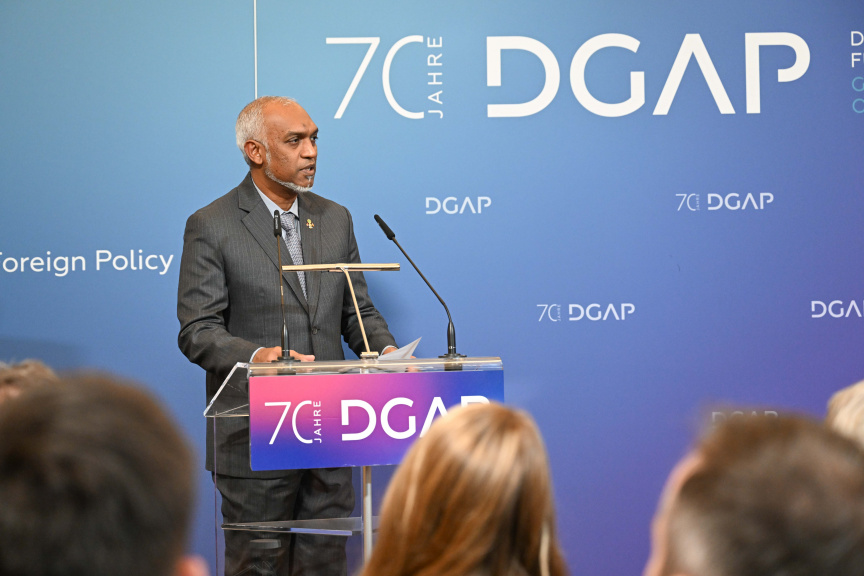
President Dr. Mohamed Muizzu states the governance of the ocean will shape both the future of small island nations and the wider international order.
He made the remark at the in his keynote address at the Deutsche Gesellschaft für Auswärtige Politik (DGAP), the German Council on Foreign Relations as part of his ongoing official visit to Germany.
In his keynote address on the role of the ocean in foreign policy, the President outlined Maldives’ perspective on coordinated ocean governance.
Our foreign policy is increasingly shaped by a simple but powerful reality: The future of international order will be determined, to a significant extent, by how we govern the oceans — President Dr Muizzu #MaldivesGermany pic.twitter.com/NDpQ7LOW5f
— The President's Office (@presidencymv) February 12, 2026
He pointed out that the ocean continues to be underrepresented in strategic and diplomatic discussions, despite its critical importance to climate regulation, biodiversity, and global food security. Stressing that the Maldives’ history, economy, culture, and security are deeply intertwined with the ocean, he underscored the extensive impact of climate change on the country’s economy and way of life.
The President noted that the Maldives is situated along key trade routes amid intensifying strategic competition, making the Indian Ocean one of the most significant regions of the 21st century. He also emphasised the need to protect undersea digital infrastructure—responsible for carrying the majority of global data traffic—through international cooperation, shared norms, and mutual trust.
He further observed that small states are increasingly playing a role in shaping global norms, championing ambitious climate action, enhanced marine conservation, and inclusive multilateralism. In closing, the President stated that an ocean-focused foreign policy is essential for the Maldives and vital for the global community. He reaffirmed the country’s willingness to collaborate with Germany and other like-minded partners to keep the ocean a domain of cooperation, sustainability, and shared responsibility. He added that ocean governance will influence not only the future of small island states but also the broader international order.
His Excellency President Dr @MMuizzu visits the Deutsche Gesellschaft für Auswärtige Politik (DGAP), the German Council on Foreign Relations. He was received by Mr Rolf Nikel, Vice President of DGAP; Mr Thomas Kleine-Brockhoff, Director of DGAP; and Dr Kira Vinke, Deputy… pic.twitter.com/QFdvrppgQ6
— The President's Office (@presidencymv) February 11, 2026
During the question-and-answer session, the President outlined the Maldives’ strategy on ocean security and sustainability, based on strong partnerships with neighbouring countries and allies, respect for territorial integrity, and environmental stewardship. He highlighted ongoing efforts to enhance capacity to protect the Maldives’ Exclusive Economic Zone and reiterated the nation’s commitment to global climate initiatives. Marking 60 years of diplomatic ties, President Muizzu also expressed interest in expanding cooperation with Germany, including in coastal protection efforts.
These remarks come as President Muizzu continues to assert that the Chagos Archipelago rightfully belongs to the Maldives. In his Presidential Address delivered last Thursday, he stated that the Maldives National Defence Force would protect the 200-nautical-mile maritime zone the country lost following the boundary delimitation between the Maldives and Mauritius by the International Tribunal for the Law of the Sea (ITLOS).
In line with that ruling, Maldivian military personnel are currently operating within maritime boundaries that ITLOS had previously designated as part of Mauritius’ territory.
In separate interviews with British and American media last week, President Muizzu reiterated his claim that the Chagos Archipelago belongs to the Maldives. He added that if sovereignty over Chagos were granted to the Maldives, a mutual agreement could be reached regarding the continued presence of the United States military base there.
The United Kingdom has since maintained that the Chagos matter is strictly a bilateral issue between the UK and Mauritius. The US has also voiced support for the UK’s stance on the dispute.
President: Governance of the ocean shapes the future of small island nations

Fetched On
Last Updated
Last Updated


