

The outbreak of a full-scale war against Iran, initiated by a coordinated military offensive from United States and Israeli forces on 28 February, has abruptly exposed the profound economic fragilities of the Maldives, a state acutely sensitive to shifts in the global order. In response to the escalating hostilities, the administration of President Dr Mohamed Muizzu has initiated an emergency mobilisation of fiscal and logistical countermeasures, seeking to insulate the island nation from a projected USD 100 million shortfall.
The crisis poses a severe, albeit indirect, threat to the republic, predicated on its heavy institutional reliance on Middle Eastern transit corridors for its primary economic engine: tourism. Approximately 30 percent of daily tourist arrivals to the Maldives travel through Middle Eastern routes, representing a critical demographic of high-spending visitors. As a nation with limited domestic production, the country remains exceptionally dependent on imports, with Middle Eastern states accounting for more than 30 percent of all inbound commodities. This dependency encompasses the entirety of the nation’s vital petroleum supply and a significant portion of basic food staples. Previous administrations failed to codify a framework to address these deep-seated vulnerabilities, relying instead on the perceived unlikelihood of a global shock, leaving the country underprepared for the current disruption.
Despite these structural impediments, the administration of President Muizzu had proactively instituted several critical policy measures prior to the outbreak of the war. Recognising the fundamental imperative of food security, the government had already compiled a comprehensive inventory of essential commodities and commenced efforts to ensure their continuous availability in the domestic market, alongside broader initiatives aimed at economic diversification.
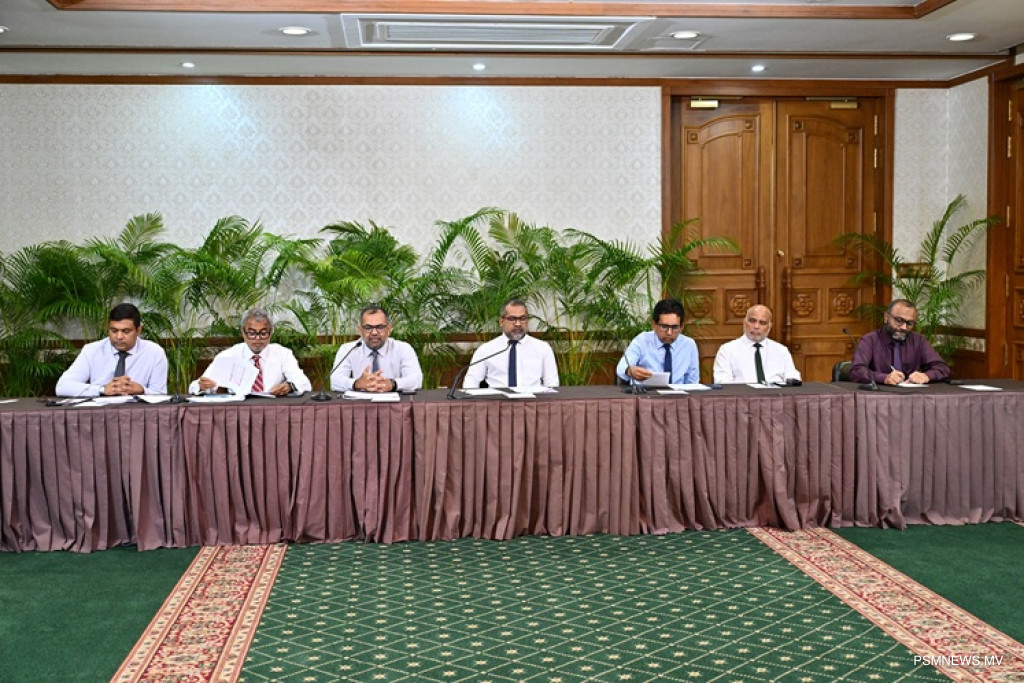
Following the initial strike on 28 February, the executive rapidly escalated its strategic response, formalising a high-level ministerial committee within six hours of the conflict’s commencement. Comprising nine ministers, the committee is mandated to monitor the evolving dynamics in the Middle East and assess potential repercussions for national security and economic stability. Operational mandates are structured around six core priorities, including safeguarding national peace and the economy by explicitly restricting Maldivian airspace from conflict-related utility and ensuring the uninterrupted provision of essential food supplies.
The committee is aggressively pursuing alternative international markets for both petroleum and staple imports, while simultaneously identifying new transportation methodologies to bypass restricted Middle Eastern airspace. Diplomatic and humanitarian efforts remain a central focus, encompassing the provision of assistance to Maldivian citizens currently residing in the Middle East and the fortification of bilateral relations with foreign nations and international organisations.
By 12 March, the committee had convened five times, prioritising the protection of the Maldivian economy alongside national safety through rigorous technical analysis and extensive stakeholder consultations. Official government research indicates that should the conflict extend for a duration of one month, the Maldives could suffer direct financial losses ranging from USD 85 million to USD 100 million. To preemptively address this projected deficit, officials announced the successful acquisition of a USD 100 million financial facility, secured through two foreign financial institutions. These funds are strategically earmarked to reinforce the national reserves required for the continuous importation of essential goods.
Government officials note that there are currently no indications of an imminent de-escalation in the Middle Eastern geopolitical landscape, yet the administration has issued strong assurances of its commitment to minimising the domestic impact of the crisis. Acknowledging the inherent lack of control over external global events, the government remains focused on localised recovery efforts and is actively preparing for worst-case scenarios to guarantee national resilience.
In the Maldives, a swift state response to a distant war and its immediate costs

Fetched On
Last Updated
Last Updated

