

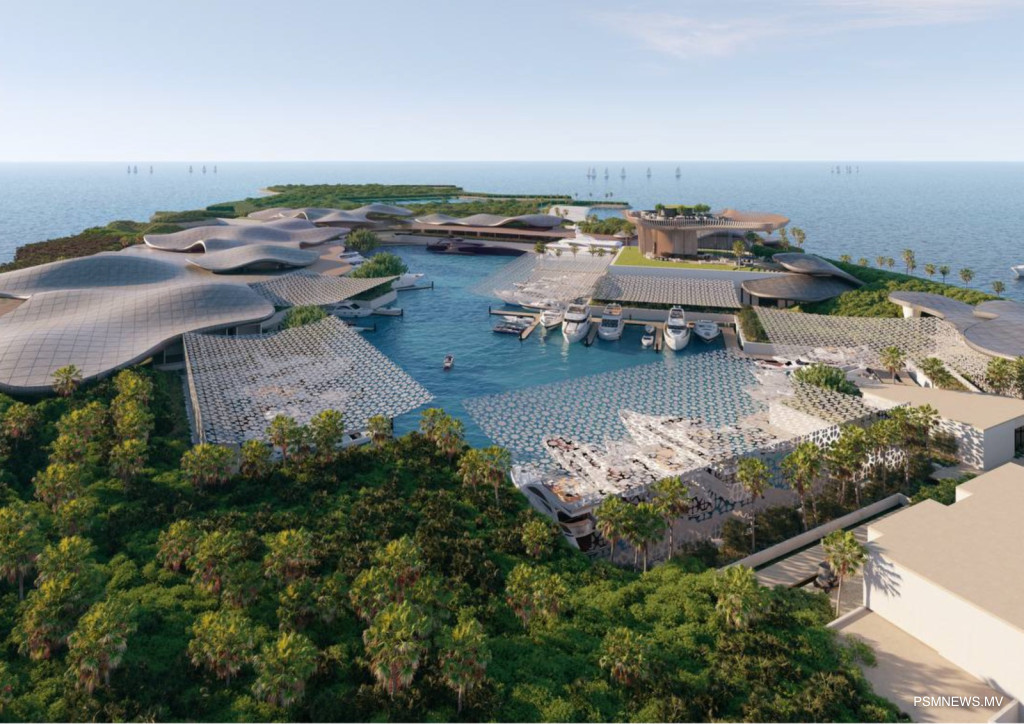
For decades, the Maldives has been defined in the global imagination by its pristine beaches, turquoise lagoons, and sunsets of rare beauty. Long regarded as a sanctuary for transient leisure, the island nation is now embarking on a transformation intended to alter that perception fundamentally. Following amendments to the Special Economic Zones (SEZ) Act, President Dr Mohamed Muizzu’s administration has authorised the country’s first sustainable township, awarding the contract to Crystal Holdings Pvt. Ltd. in December.
The project, known as ‘Ayla’, is located in Noonu Atoll, spanning the lagoons of Dhighufaru, Dekunufaru, and Kuramaadhoo. With land reclamation and shore protection completed and ground broken, the development marks a decisive departure from the Maldives’ resort-centred model. Officials underscore that Ayla is not another enclave for short-term visitors but a township conceived for sustainable, long-term living. The nation’s strategic focus has shifted: rather than asking how many tourists will arrive, the Maldives is now considering how people can permanently inhabit its islands.
At the foundation ceremony, Minister of Economic Development and Trade Mohamed Saeed highlighted the broader implications. “Projects such as Ayla will compel the global community to recognise the Maldives not merely as a holiday retreat, but as a prime destination for habitation and investment,” Minister Saeed said.
“This initiative will significantly elevate the visitor experience across lifestyle, education, wellness, and healthcare sectors. It represents a pivotal opportunity for the nation to be acknowledged as a hub for long-term, high-value endeavours, rather than solely a temporary vacation spot,” he added.
For half a century, the Maldives’ economic strategy has relied heavily on isolated island resorts. This USD 750 million undertaking signals a comprehensive reorientation. Designed as an interconnected community, Ayla is intended to support family life, higher education, and advanced healthcare. Advocates contend that, amid mounting congestion in the capital Malé and the migration of youth abroad in search of opportunity, such a development is both timely and necessary.
Central to the project’s philosophy is permanence. These are not rooms for guests, but homes for citizens. Conscious of the archipelago’s environmental fragility, developers have pledged adherence to a rigorous sustainability framework, ensuring that at least 60 percent of the township’s energy requirements will be met through renewable sources. The infrastructure plan also incorporates modern waste management systems and agricultural protocols, with 17 hectares of land dedicated to food security.
Ayla also offers a rare opportunity to diversify beyond tourism, which remains the Maldives’ largest source of national income. The township will host educational facilities capable of training 100 hospitality professionals simultaneously, alongside luxury villas and marinas. Plans include advanced medical infrastructure, such as multi-place hyperbaric chambers and therapy centres. By partnering with international federations to provide athlete recovery and rehabilitation services, and by attracting technology specialists, the initiative aims to generate employment sectors outside traditional tourism. In doing so, it seeks to create pathways for young Maldivians to pursue careers within their own borders.
The government has set a target to complete the project by the end of 2028. Upon its conclusion, the vision is for these islands to evolve from a paradise where visitors “check out” to a permanent sanctuary where daily life endures. While the Maldives has long been celebrated as a destination for the world, the current administration’s ambition extends further: to build a nation where people do not merely visit, but where they truly belong. Officials believe this marks a hopeful new chapter in the story of the island nation.
Redefining Maldives With Project Ayla: From Tourist Retreat to Permanent Home

Fetched On
Last Updated
Last Updated


