

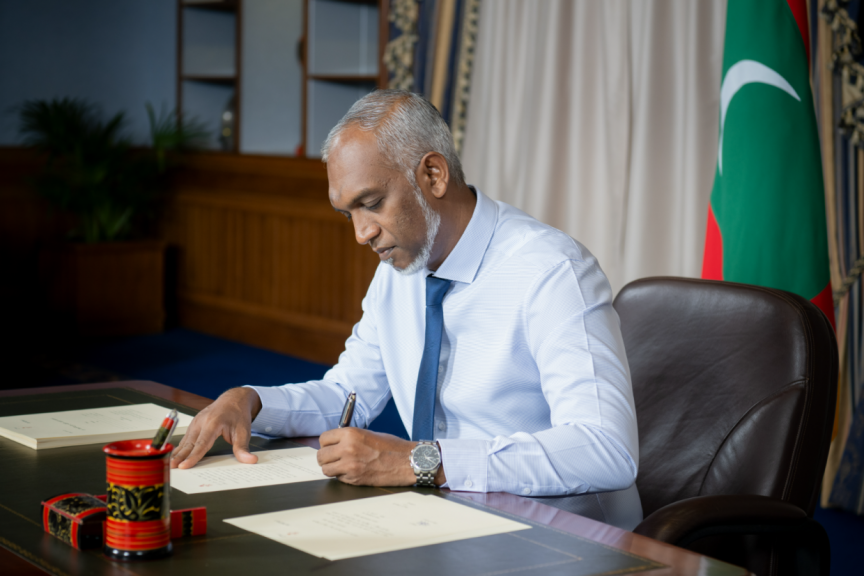
President Dr. Mohamed Muizzu, on Monday, has ratified the amendment necessary to abolish atoll councils.
The constitutional amendment, along with the proposed amendments to the Local Council Election Act and the Decentralization Act, would remove the term “Atoll Council” from both laws, effectively disbanding these councils and ending elections for their members.
The amendment to the constitution was passed by the 20th parliamentary assembly during its 24th sitting of the third session of 2025, held on Tuesday, November 25th.
This constitutional amendment removes the provision for forming atoll councils under the decentralized administrative system. The dissolution of atoll councils will take effect with the first local council elections held after the amendment is ratified, and current atoll councils will remain in office until the newly elected councils assume their mandates.
Meanwhile, the eighth amendment to the Local Council Elections Act was passed by the 20th parliamentary assembly during its 24th sitting of the third session of 2025, held on Thursday, November 27th, as was the 17th amendment to the Decentralisation Act.
The amended Local Council Elections Act brings important changes aimed at strengthening the election framework for City Councils and Island Councils, setting out clearer principles and procedures for how these elections are to be conducted. It also mandates that by-elections to fill vacancies on Local Councils, as outlined in the Decentralisation Act, must be held twice a year.
Under the updated Decentralization Act, island councils would report directly to the Local Government Authority (LGA) rather than to Atoll Councils.
Under the amendment, island councils will be structured according to population size. Islands with fewer than 2,000 people will be represented by a three-member council that includes one woman, while islands with 2,000 or more residents will have a five-member council with two women councillors.
The Malé City Council’s size will match the number of MPs elected from Malé City, along with the mayor. In Fuvahmulah, the city council will comprise the mayor and eight ward representatives.
For city councils, seats reserved for women must be evenly distributed across all constituencies, following guidelines set by the Elections Commission.
The Women’s Development Committees will also see changes. The WDC Chairperson will now serve as a full-time, elected official, chosen by eligible voters. Additionally, one WDC Chairperson will be elected to serve on the LGA Board.
The amendment also outlines situations in which a councilor will lose their seats. This includes leaving the political party they were elected under, joining another political party, or registering with a political party after being elected as an independent.
The amendments have taken effect following its ratification and publication in the government gazette.
Pres. Muizzu ratifies amendment to abolish atoll councils

Fetched On
Last Updated
Last Updated


